Teachers' Day
Versione italiana
Giovedì 15 ottobre 2026, ultimo giorno del convegno, ci sarà un workshop sulla creatività, per uno scambio reciproco di idee tra ricercatori e ricercatrici partecipanti di CMSC 2026 e insegnanti delle scuole primarie e secondarie di primo grado.
Il programma include presentazioni plenarie su invito e workshop, sotto forma di tutorial e laboratori interattivi, di interesse per i e le docenti. Queste attività includono anche alcuni articoli scientifici accettati per la conferenza di CMSC 2026, dando la possibilità agli autori e alle autrici di presentare il proprio lavoro e illustrare come possa essere utilizzato o adattato per un’attività in classe. Per ogni attività, sono specificati speaker(s), titolo, abstract e linguaggio di erogazione (italiano o inglese).
La partecipazione per i e le docenti è gratuita. Ci sono ancora pochi posti disponibili, per iscriverti compila il seguente modulo: Registrazione al Teachers’ Day – Max. 50 posti disponibili; logica FIFO.–>
English version
On the final day of the conference, Thursday, October 15, 2026, there will be a hybrid workshop on creativity for the mutual exchange of ideas between CMSC 2026 researchers and primary and secondary school teachers.
The program includes include invited plenary presentations and workshops, as tutorials and interactive activities, of interest to teachers. These also include some scientific articles accepted for the CMSC 2026 conference, allowing authors to present their work and illustrate how it can be used or adapted for a classroom activity. For each activity, we specify speaker(s), title, abstract, and delivery language (Italian or English).
Participation for teachers is free, but registration is required by October 2, 2026. Please complete the following form: Teachers’ Day Registration Form – Maximum of 50 places available; first-come, first-served logic.
| Schedule | Tipo/Type | Speaker | Titolo/Title | Abstract | Linguaggio di erogazione/ Delivery language |
|---|---|---|---|---|---|
| 08:30 – 08:45 | Registrazione/Registration | ||||
| 08:45 – 09:00 | Introduzione/Opening | ||||
| 09:00 – 09:35 | Invited |  Frances Rosamond University of Bergen, Norway | Creative Mathematical Sciences Communication: From Research to Hands-On Learning | The presentation will give a brief history of the Creative Mathematical Sciences Communication (CMSC) international education initiative. The CMSC conference series began in Darwin, Australia, in 2013 and has met every two years since, bringing together mathematics and computer science researchers, teachers, dramatists, dancers, storytellers, and visual and performing artists. CMSC has a distinctive goal: to transform ideas and research questions from modern mathematics and computer science into hands-on, kinesthetic activities, inspired by the philosophy of Computer Science Unplugged. These activities allow students—from primary school onward—as well as interested adults to experience and explore computational ideas without requiring computers. The presentation will include examples of activities developed through CMSC and CS Unplugged that introduce ideas from artificial intelligence and algorithms. Come and see how physical activities and storytelling can make sophisticated computational concepts accessible, memorable, and fun. | English |
| 09:35 – 10:20 | Workshop | Michael Lodi University of Bologna, Italy and Agnese Del Zozzo, Alberto Montresor University of Trento, Italy and Giorgia Bissoli Verona Fablab, Italy | Grucce e cannucce: algoritmi unplugged a costo (quasi) zero per il primo ciclo | In questo laboratorio sperimenteremo due attività unplugged a costo quasi zero per introdurre gli algoritmi nel primo ciclo. Con una gruccia usata come bilancia cercheremo il più pesante fra alcuni sacchetti; con delle cannucce colorate, parzialmente nascoste alla vista, affronteremo invece un problema di ordinamento. Lavorando in piccoli gruppi, inventeremo e confronteremo strategie, ragionando su un’idea fondamentale dell’informatica: un algoritmo deve essere una procedura precisa e non ambigua rispetto a uno specifico esecutore. Vedremo infine come proseguire le attività al computer e presenteremo una guida (PDF liberamente scaricabile) per docenti del primo ciclo, con attività, approfondimenti disciplinari e suggerimenti didattici per insegnare informatica anche senza una formazione specialistica. | Italiano |
| 10:20 – 11:05 | Workshop | Christophe Stammet Université du Luxembourg, Luxembourg | Inside the Brain of ChatGPT: Hands-On Activities to understand generative AI | In this workshop, we will look behind the scenes of generative AI tools such as ChatGPT and DeepL and discover how generative AI learns to understand human language. You will learn how AI encodes the meaning of words, how it connects words to one another, and how it acquires an understanding of the nuances of human language. Through practical activities suitable for classroom use, we will explore the strengths and limitations of this technology together. We will see that while our own creativity and critical thinking remain essential, generative AI can support us effectively in many situations. | English |
| 11:05 – 11:35 | Coffee break | ||||
| 11:35 – 12:10 | Invited | 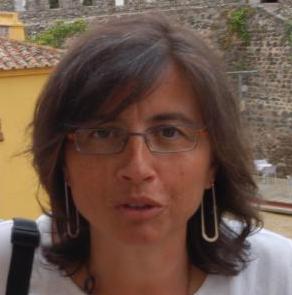 Maria Francesca Carfora Consiglio Nazionale delle Ricerche, Istituto per le Applicazioni del Calcolo “Mauro Picone”, Italy | Palestra matematica (perché anche il cervello ha bisogno di allenamento) | In questo laboratorio presento alcune attività raccolte nel corso degli anni e sperimentate con classi di studenti delle scuole primarie e secondarie di primo grado. Attraverso oggetti realizzati con materiali poveri si gioca, si sperimentano proprietà geometriche e topologiche, si deducono regole, si generalizzano procedure lavorando in piccoli gruppi. I partecipanti al laboratorio saranno infine coinvolti nella valutazione dell’esperienza e nella progettazione di una nuova attività. | Italiano |
| 12:10 – 12:55 | Workshop | Adithi Iyer Indian Institute of Technology, India | No Thanks! | The workshop will introduce participants to No Thanks!, a simple card-and-token game that connects integers and involves making strategy around integer operations through play. Teachers will experience the game as learners by playing it in small groups. I will first explain the rules and facilitate an initial round to ensure everyone is comfortable with the gameplay. Participants will then play a second round independently, allowing them to develop and discuss their own strategies. The session will conclude with a discussion on the mathematical ideas that emerge naturally from the game, including decision-making, scoring, and patterns. | English |
| 12:55 – 14:00 | Lunch break | ||||
| 14:00 – 14:35 | Invited |  Daniela Valenti, Centro Montessori SPES Padova, Italy | Astrazioni materializzate: la mano che costruisce il sapere | Dai numeri naturali ai numeri relativi: un percorso di di acquisizione di conoscenze matematiche nella scuola primaria a Metodo Montessori. Si presentano con il Materiale Montessori i passaggi di addizioni in riga col Serpente Positivo, addizioni e sottrazioni in riga col Serpente Negativo finalizzati al calcolo a mente per arrivare alla scoperta dei numeri relativi e ad eseguire addizioni algebriche col Serpente Algebrico. | Italiano |
| 14:35 – 15:20 | Workshop | Marika Parviainen University of Turku, Finland and Valentina Dagiené Vilnius University, Lithuania | Think–Solve–Reflect: Algebraic and Computational Thinking for Teachers | Discover how algebraic thinking and computational thinking can work together to enrich primary school mathematics education! Drawing on the power of learning analytics and the engaging task formats of the Bebras Challenge (bebras.org), we explore how digital tools can support an integrated problem-solving approach: Think – Solve – Reflect. In this hands-on workshop, teachers explore a range of mathematical problems and discover how computational thinking strategies can help students tackle them in new and more effective ways. We will work through practical examples, experience the approach first-hand, and explore ways to integrate computational thinking naturally into everyday primary mathematics teaching. Teachers, come and discover how thinking like a computer scientist can help students think like mathematicians! | English |
| 15:20 – 16:05 | Workshop | Laura Antonelli Consiglio Nazionale delle Ricerche, ICAR and Maria Francesca Carfora Consiglio Nazionale delle Ricerche, IAC | GENIUS | GENIUS is a collaborative mathematical game designed to engage participants through riddles and problem-solving activities covering different areas of mathematics. | Italiano |
| 16:05 – 16:35 | Coffee break | ||||
| 16:35 – 17:20 | Workshop | Neha Garg Indian Institute of Technology, India | Dicey Dice | Dicey Dice is a two-dice betting game in which players make decisions about where and how much to bid. As the game unfolds, participants will articulate the reasoning behind their decisions and facilitated questions will invite them to investigate the mathematics of the game - Which sums on two dice are more likely? How many ways can a particular sum occur? How does this affect the strategy of the game? The workshop will use the game to demonstrate how facilitated gameplay can create opportunities in classrooms to surface intuitions in probability, and articulate and examine the reasoning behind them. | English | 17:20 – 17:55 | Workshop | Federico Malucelli Politecnico di Milano, Italy | Can we use shortest paths to make decisions? The example of a playful scheduling problem | We will propose a simple scheduling problem. The problem consist in deciding the minimum time sequence of a bridge crossing. The workshop may involve a physical activity by groups of 4 persons that will mimic the bridge crossing. After finding the solution intuitively, we will validate it through the use of a shortest path model, thus taking advantage of the model discussed during the conference. | Italiano |
| 17:55 – 18:00 | Conclusione/Closing | ||||